

Civility Saves Lives
Incivility refers to speech or behaviour that is mildly to moderately rude, discourteous, or disrespectful.
Importantly, incivility is defined by how it is experienced by the recipient. What one person considers harmless, another may perceive as rude or dismissive.
Examples of incivility include:
-
Shouting or raising your voice
-
Swearing
-
Aggressive behaviour (even if not directed at another person)
-
Belittling or dismissing others
-
Sending emails or using a phone while someone is speaking in a meeting
-
Talking over colleagues
-
Being abrupt or difficult during telephone conversations
-
Rolling your eyes, sighing, or tutting
Everyone has different perceptions of what constitutes rude behaviour, and our tolerance levels vary. However, we all have a point at which behaviour crosses the line. When it does, the consequences can be significant—for individuals, teams, and ultimately, patient care.
Experiencing rudeness reduces our cognitive bandwidth—our capacity to manage multiple tasks, process information, and make sound decisions.
On a typical day, most people can actively manage six to eight different thoughts or tasks at once. When someone behaves rudely towards us, part of our mental capacity becomes occupied by processing that negative interaction. As a result, we have fewer cognitive resources available for the tasks that matter most. In effect, incivility makes it harder for us to perform our jobs safely and effectively.
Research by Christine Porath demonstrated that workplace incivility can result in a 61% reduction in cognitive performance, highlighting the significant effect that rude behaviour has on thinking, concentration, and decision-making.
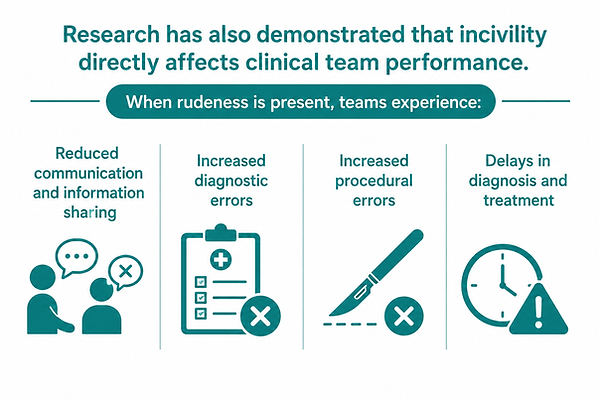
The effects of incivility do not stop with the person directly involved and the impact extends to those who witness the behaviour.
Studies have shown that observing rude behaviour can lead to:
-
A 20% decrease in performance
-
A 50% reduction in willingness to help colleagues
This weakens teamwork, reduces collaboration, and creates an environment where people are less likely to support one another.
Further analysis found that more than half of the decline in team performance could be directly attributed to the presence of rude behaviour.
These findings reinforce an important message: civility is not simply about being polite—it is a patient safety intervention. By treating one another with respect, we protect our colleagues, strengthen teamwork, and help deliver safer, higher-quality care.
Watch the short video below for an introduction to the Civility Saves Lives initiative. For more information visit the Civility Saves Lives website.
Associated
Sample
Questions
-
Describe a situation where you had a conflict with a colleague
-
Describe a situation where you delt with conflict within your team
-
If the conflict was caused by problems with an individual’s values and behaviour, how would you approach this?
-
-
If you work are working with a colleague for the first time and he/she was being abusive and bullying another staff member what would you do?
-
After working as a consultant for a few months, you notice that a consultant colleague has been repeatedly denigrating a nurse who is clearly becoming more upset. How would you deal with this?
-
Can you give an example when you witnessed incivility at work and what did you do about it?
-
Can you give an example where you were disappointed in your own behaviour/actions at work?